Politics & Security
Is Ethiopia Now Fighting Alongside Al-Shabaab in Somalia?
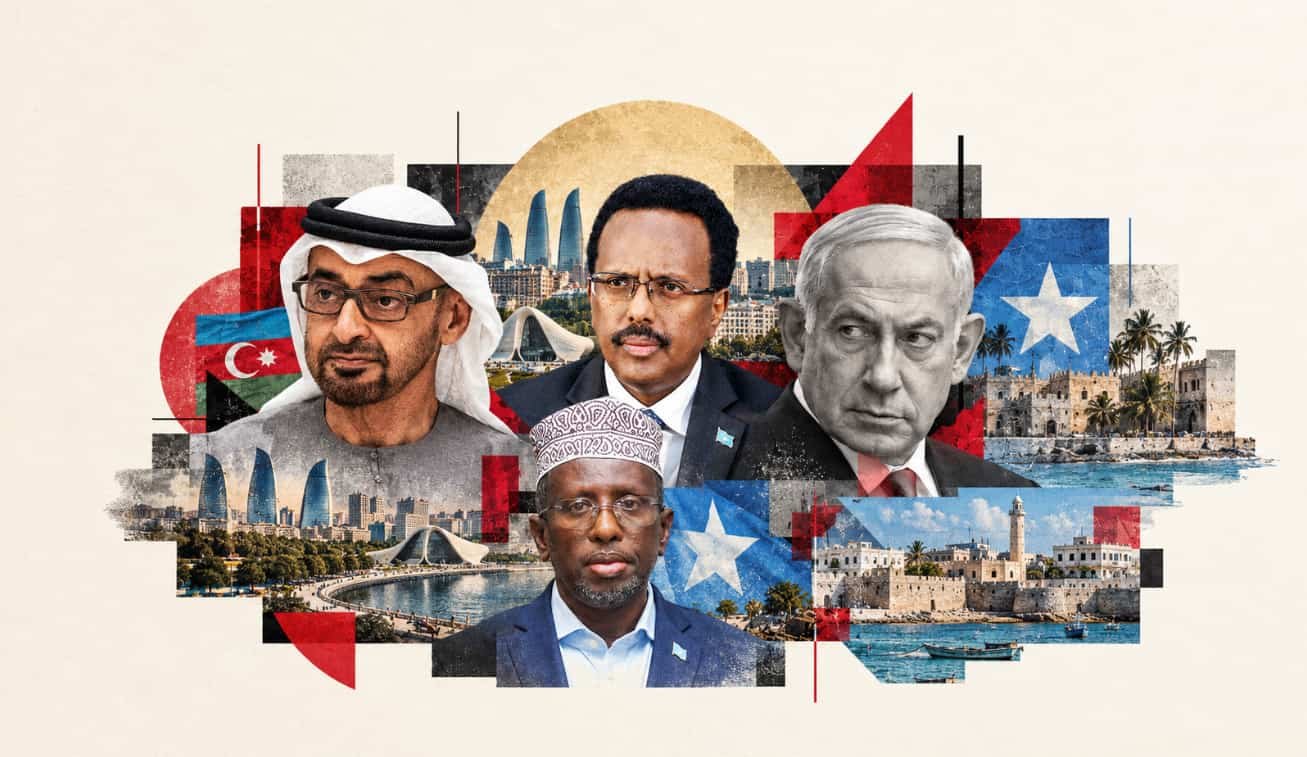
Sometimes a single map says more than hundreds of articles written over the years. On the evening of October 18, 2026, as Israeli Prime Minister Benjamin Netanyahu unveiled his country’s new national security doctrine, a map of the Middle East stood behind him. It divided the region into rival blocs: Türkiye, Egypt, Pakistan and Saudi Arabia in dark green as a “Sunni Diamond,” and Israel and the UAE in blue as a “Hexagon Alliance.” In the Somali portion of the map was a striking detail: Puntland and Somaliland were shaded in light blue, the color designating territories Israel and the UAE regard as friendly.
Somaliland’s presence surprised no one. Israel recognized Somaliland’s independence in December 2025. The real question was Puntland. In other words, Said Abdullahi Deni.
The author of this piece has been saying the same thing almost every day for two years: Said Deni is the UAE-Israel axis’s most critical partner in the Horn of Africa. Seeing it today on a screen behind an Israeli prime minister is not new information. But it is now an undeniable record.
Fairness matters. The map was not produced by Israel; it carries the logo of the Friedrich Ebert Stiftung, a foundation close to Germany’s Social Democrats. Puntland has no diplomatic relations with Israel and has not recognized it. Some commentators in the Somali press argue that Puntland was placed in this category not because of direct dealings with Israel, but because it hosts the UAE’s partners.
But that is precisely the point. What placed Puntland in that blue zone is not a formal agreement; it is a network of relationships built on the ground over years. And when an Israeli prime minister chooses to display this map while unveiling his national security doctrine, the choice is no accident. Netanyahu did not make clear whether he regards every country on the map as an adversary; but he did not shy away from showing who his friends are.
The real reason Said Deni appears on this map is Bosaso.
Over the past two years, Puntland’s port city has become one of the silent links in the logistics chain of Sudan’s war. According to a senior commander of the Puntland Maritime Police Force who spoke to Middle East Eye, IL-76 cargo aircraft have routinely landed at Bosaso Airport over two years, unloading sealed containers under armed guard, with the cargo allegedly reloaded onto flights bound for Sudan through neighboring countries. There are also reports of Colombian mercenaries transiting Bosaso to join RSF ranks in Sudan; a Colombian contractor interviewed by The Guardian confirmed the route.
These allegations do not come only from opposition media. Somalia’s defense minister acknowledged that aircraft regularly depart Bosaso Airport for Sudan, but said the federal government has no information about their cargo or final destinations. Sudan’s government also lodged a formal protest with Mogadishu over reports of Bosaso’s role.
Sudanese know very well where the cargo on these flights ends up. The RSF has been accused of widespread atrocities since the war began, and the fall of El Fasher became one of the darkest chapters of that brutality. Every plane taking off from Bosaso is part of this picture. As the ruler of the territory where these planes land, Said Deni cannot stand outside the responsibility.
Deni’s secret visit to the UAE just days after the reports surfaced, and the silence of Puntland’s authorities on the matter, did not blur this picture. They sharpened it.
Somaliland’s leader, Abdirahman Cirro, does not hide who he is. He travels to Israel, celebrates recognition and openly defends his separatist project. Everyone knows how to respond to him.
Said Deni is different. Without abandoning the rhetoric of “one Somalia,” and speaking the language of federalism and autonomy, he stands within the same axis. He presents himself as one of the loudest voices of opposition to Mogadishu, while on the ground he opens the door to the UAE’s weapons corridor. This double game makes him far more dangerous than Cirro. Cirro says he stands outside Somalia; Deni speaks from within.
The real question now lies before Somalia’s opposition.
For the past two years, the opposition front against the government in Mogadishu has posed shoulder to shoulder with Said Deni, signed joint statements and sat at the same tables. The justification was always the same: “We are against Mogadishu, against Hassan Sheikh’s authoritarian drift.” Those criticisms may be legitimate. Somalia faces real and serious debates over its electoral system, constitutional amendments and the balance of power between the center and the regions.
But there is a deep difference between opposing a government and serving as an extra for an axis that threatens a country’s territorial integrity. Today, that difference sits on a map as a blue stain.
The opposition now faces a choice. Either it looks at this map, puts distance between itself and Said Deni, and proves that its opposition is in the name of Somalia’s sovereignty. Or, under the pretext of “we are against Mogadishu,” it keeps playing local extras for the Tel Aviv–Abu Dhabi line.
Maps sometimes exaggerate, sometimes simplify. The map behind Netanyahu is not flawless either. But it lays bare one truth: Israel and the UAE know who their friends are in the Horn of Africa, and they no longer feel the need to hide it.
No one in Somalia can say “we didn’t know” anymore. Who Said Deni is, what Bosaso is used for, and what this axis means for Somalia’s future now sit on a screen, in front of the whole world. Only one question remains: will Somalia’s opposition have the courage to see its own place on this map?